Thursday, 22 January 2015

The Curse of Peladon

            What is it about The Curse of Peladon?
            I enjoyed much of Season 8. I admired The Dæmons. But I was enthralled by The Curse of Peladon. I watched the first episode in a state of delight. Just the thought of it put me in a good mood. Having just finished Episode 4 with much the same feelings, I find it's probably - very possibly - my favourite Pertwee story so far (tied with Spearhead and Dæmons).
            What's so special about it?
            The Doctor and Jo Grant arrive on the world of Peladon, in a dreadful storm, when Jo really should be sipping Pernod and Black with Mike Yates in one of Tarminster's more happening wine bars. Instantly, this story has a sense of occasion. It's Saturday night on Earth, and like other teenagers in Great Britain, she has to spend a bit of time with Doctor Who before she can escape to the discotheque, for Labbi Siffre's It Must Be Love and Cilla's even more pertinent Something Tells Me Something's Gonna Happen Tonight.
            The Tardis is lost - no way out - and they are impelled up a mountain, through a secret passage, into a citadel built into the very fabric of this inhospitable world. We happily accompany them, because they're written with a lightness of touch and because Pertwee and Manning have a sublime rapport by now. The Doctor's tetchiness is wreathed in smiles and affectionate teasing.
            So we are drawn into this strange space: the cosy refuge from the storm. Inside a mountain, outside our world, out of the storm, into danger. All the lives and history of this world, boxed up in one excursion in the Tardis, parcelled up inside Jo's Saturday night on Earth. The castle on the mountain encapsulates all that is Peladon, and tonight it even seems to encapsulate the galaxy, with representatives from distant stars gathered all together.
            As the Doctor and Jo move deeper into this world, there's that cosy feeling of a world imagined entire: the world of the story. Perhaps it feels more this way because of its fairy tale quality: the castle on the mountain, the boy king who has to prove himself, the magician with his mysterious princess.
            Of course, this is an old-fashioned Doctor Who feeling, one we've had to do without for a while. It used to be that every Episode One began with our heroes walking into a new narrative and a new world. With the canvas blank again each time, the Doctor and his companion can be the vehicle for any kind of story, and any/every law of the universe is potentially unstable: we flirt with a feeling of total otherness. Normally, this is dismissed quite quickly by someone in a PVC nappy jogging across a quarry, but the challenge can inspire stories like The Celestial Toymaker (by someone called Brian Hayles). It's the televisual equivalent of 'Once upon a time, there was...'
            What deepens the pleasure of this fairy tale world is the arrival in it of the Ice Warriors. We've taken a side-step into another world,  but - a very particular world. The world of Doctor Who! Where cold-blooded cyborg viking dragons swish haughtily about, sometimes with evil plans involving space mushrooms, sometimes on diplomatic missions to Narnia. And not only that, but as soon as they turn up (looking fabulous onscreen, which is a relief after the doddery Daleks) the Doctor is once again a man who has lived and died twice. The sort of man who can remember visiting future Earth buried under ice age, as well as he can remember Elizabeth I's coronation.
            None of this is interferes with the actual story. You could watch and follow this story knowing nothing about the show - but you'd be constantly aware that it's a show about friendship over isolation, rationality over superstition, looking your best and holding your own and trying to do what's best, even when you're completely out of your depth. There's a hermaphrodite with six arms, a gremlin covered in slime riding on top of a drinks machine, and a fey young man in an outfit that could have Jacqueline Pearce saying, 'Mm, it's a bit much...' - and they all want to get along.
            Well, not the gremlin on the drinks machine. He wants exclusive mineral trading rights with a man who looks like a badger.
            The audience can follow it. The actors know what to do. The direction is fluid. Firelight flickers. It doesn't just work - it unfolds.
            At one point, the Doctor points out to Jo how drastic the situation is: it's not about a bomb about to go off. It's about a vast, diplomatic conflict. The Doctor and Jo, taking the roles of politicians, have to engage in arguments and win the support of querulous cephalopods, not to defuse a machine but a situation bigger than any of them.
            Come to think of it, that's the threat posed in The Mind of Evil and Day of the Daleks, too. But in this story - particularly because Hepesh and Peladon are well-intentioned men who make bad decisions - the story really convinces you of that threat.
            And brilliantly, in a huge progression from all her other stories so far, Jo Grant is instrumental in saving the day! The Doctor sends her into the delegates' conference to persuade them to do what she thinks should be done. Jo is an active participant in the story. She talks to everyone, argues about everything, falls in love, pleads for the Doctor's life. She doesn't just react to the action, she goes right inside that story and makes stuff happen.
            Now, perhaps I'm being sentimental, but there is something special about a writer returning to Doctor Who. Yes, of course, I'm being sentimental - I've read Robert Holmes' biography, the story of a man who kept being called back to silly old Doctor Who because it was easy to write and paid well enough, while his own personal writing projects pootled along, or more often petered out. But there is something about a writer like Brian Hayles (or indeed, Holmes or Terrance Dicks) who writes the series in acknowledgement of its basic absurdities, its impossibility, its openness.
            In the previous story, the Doctor zapped an Ogron with a ray gun. In this story, the humanoid characters are the most murderous, and even the Ice Warriors are friendly. This is a story which belongs to the world of the Doctor: transcendental, absurd, cosy, and full of ideas.

            What's up next...?


Thursday, 15 January 2015

Day of the Daleks

They recast the Doctor, created a new environment for him, found the formula for ratings success. Having iced the cake, it's time to stick a few Daleks on top. But are they the delicious glacé cherries that add the real flavour to the cake, or just glittering candles to add a bit of sparkle to the ensemble?

To stretch my delicious metaphor a little further, this is a story with brilliant ingredients. Coming after the "Magic!" "Science!" "Magic!" "Science!" dialectic of the previous story, here the Doctor cheerfully assures us that ghosts are possible. Not only that, but when he's around, you get a rare kind - ghosts of people who haven't been born yet. Perhaps even ghosts of people who'll never exist! And where better to encounter them than an old stately home?

This era's gothic urban landscape - factories disgorging Satanic slime, laboratories whose doors are frequently kicked in by monsters, B-roads patrolled by murderous automata - is expanded to include railway tunnels infested with ape-men. Its seething background of political drama - glimpsed in The Mind of Evil - returns as imminent World War. And slowly we uncover more about the world after the war - a stylish dystopia to rival Inferno.

Plus, the Daleks strap the Doctor to a mind-scanner and, thrillingly, summon up images of his earlier selves. Their mortal enemy, stretching back through eternity, or a generation of television viewing (which is similar)!

Unfortunately, the result is a crushing disappointment. If it was a cake, Mary Berry and Paul Hollywood would be looking extremely miffed.

The performers are all fantastic. Jo Grant is trusting and good-hearted. Aubrey Woods is wonderfully sinister, a human being with all his humanity eaten away (I always thought there was something iffy about that sweetshop owner in Willy Wonka and the Chocolate Factory). His zombie dollybirds are extraordinary, and under-used. You couldn't ask for more from Jon Pertwee, particularly in his scenes with Woods. The Controller is 'a quisling, a traitor!' - the victims of the regime are 'old men and women, even children': in one argument, we feel the force with which the Daleks' regime grinds down.

This is necessary, because we don't feel much of it elsewhere. When they appear onscreen, the Daleks are a shadow of their former selves. What's the sound equivalent of a shadow? A poorly modulated bleat? That too. Much as it's an impressive way of presenting them - already the masters of Earth, no shilly-shallying like the villains of Seasons 7 and 8 - they're really not integrated into the story, and criminally there are no big confrontations between them and the Brigadier or the Doctor, or even Jo.

I mean, come on. These are the effin' Daleks!

The direction's limp, with the modern day particularly lacking in atmosphere. A hint of  The Daemons' Dennis Wheatley theatrics would have come in handy for the ghosts at the mansion, which is lit like something out of a sit-com. But having presented them as looking simply like terrorists who have travelled through time, the script takes ages to explain that this is the case. Yes, I know that's okay - we can assume the audience picked it up for themselves - but it misses every dramatic use of time travel, and Aubrey Woods might as well be in a space ship with a transmat hovering overhead.

Equally, the Daleks could have been anyone. There's no sense that there are living beings wiggling those egg-whisks. The whole story would be improved for having Aubrey's zombie dolly-birds as the dominating evil regime. Can't you just see them marching towards that manor house, flanked by Ogrons?


Well, it was nice to look forward to. I'll just have to accept it didn't work out. The nice thing about Doctor Who is that the story has a sort of after-life in the memory: I fancy reading the novelisation at some point, too. Meanwhile, it's time to get really 'out there'...


Thursday, 11 December 2014

All Together Now ... Season Eight

Here we go, then; like a murderous doll coming back to life in a warm car, like Jon Pertwee lassoing a psychic, psychotic machine with copper wire,  I am taking charge of this blog. I am channelling all the power of the Nuton Energy complex back into the space vampire that is my life. Eko! Eko! The Dandy!

Yes, I skipped a couple of stories. Well, a whole season. And what a season! Let me bring you up to speed...

I must say, Dr Who sometimes seems his own worst enemy. Exiled to live life one day after another on the same planet, does he exorcise any of his wanderlust by traversing the globe, exploring the places he hasn't visited: Berlin, San Francisco, Tokyo? No, he hunkers down in Tarminster, chucking in a couple of trips out to a prison or a power station. The weather's usually dreadful, wherever he goes. Perhaps it's why he's eternally snappish?

A couple of incarnations ago, of course, he was hardly Prince Charming. As an impetuous young grandfather, he could hardly stop himself being tetchy in order to be patronising. What's the difference here? Perhaps it's that Pertwee (51, here) seems so much the younger man, for all that his curling white hair is his own, unlike Hartnell's (55 in his first story). His mind is pin sharp, and so is his tongue - and everyone ends up on the wrong end of it, eventually.

Of course, he's going through a difficult period. As if exile to the Home Counties wasn't bad enough, at the start of this season his side-kick Liz Shaw has just quit his company after what sounds like a row: later that day he finds a criminal megalomaniac has moved into his territory. The Master's like the neighbour from hell, except he's really just passing through - his vehicle isn't metaphorically sitting on a pile of bricks in the garage. Soon, everybody's  asking 'Who is this Master guy?' All the Doctor gets is grief from civil servants.

Of course, the Doctor isn't so badly off. Liz may have gone off to handle her own test tubes in Cambridge, but UNIT has a new recruit in the form of Josephine Grant. I should note here that I didn't watch her first story, Terror of the Autons (not enough stories with Terror in the title these days, I find) on DVD, or VHS, or at all. I've leant it to someone, and I know it backwards anyway - so I decided to try Terrance Dicks' novelisation. And it's brilliant!

It's light on its feet, effortlessly sketching in the backgrounds of characters who essentially appear on telly in order to be terrorised by Roger Delgado and his blank-faced henchmen, including Jo Grant herself: he spins a real story out of the TV version’s cavalcade of set-pieces (in retrospect, the TV version is just four episodes of cliffhangers) (but what cliffhangers!). On Jo's first day, she's already heard of the Doctor - you picture him as something of a public figure - and Dicks draws a real narrative out of her First Day from Hell.

I have to admit, though, I don't get a strong sense of Jo after her first five stories. Everything feels quite new to her - in Colony in Space, she doesn't even believe the Tardis can fly through time and space (so goodness knows what she thought was going on in The Claws of Axos, when much is made of the Doctor's vanishment in a cosmic huff). The Dæmons gives her some fun dialogue, baiting the Doctor - she even saves the day - but in many ways she still feels a supporting artist: someone to ask questions and lug trees out of the way of Bessie. The Brigadier, by comparison, is barely involved in the story proper but gets constant character notes and moments of triumph.

Katy Manning is, of course, fantastic - her finest hour being, probably, The Mind of Evil, when her compassion for Barnham is a nicely played counterpoint to the vicious machismo exploding at every hand. She also has to take care of the Doctor after he is nearly destroyed by the nightmares induced by the Keller Machine. This story features one of the only real character moments for the pair of them - until The Dæmons, which is in quite another register - with the Doctor reminiscing about his travels to his young companion. If she thinks he's Baron Munchausen at this point, she's more than prepared to humour him. It's the kind of scene you'd get constantly now - the fact that it's so rare here only makes it more cherishable.

She also gets quite a lot to do in Colony in Space, although much of it involves being held hostage and rescued. I love the moment when she and a colonist are chained to a bomb in a cave. 'What do we do now?' he asks her. She shrugs, almost blithely: 'Escape?' It's a rare moment of strength for Jo, and Manning's performance is entirely adorable. Her performance - innocent, frequently outspoken - is just crying out to be matched by Roger Delagado's.

Delgado is perfect in every story. If it was hard to ever imagine Patrick Troughton as a Lord of any kind, the Master oozes the confidence and glamour of the aristocracy. The universe is a giant costume party for the Master, and whilst he might start this series masquerading as an electrical engineer, it's not long before he's a High Court Judge In Space, a vicar and the leader of a black magic coven. It's a shame we always see him at work - it would be fabulous to observe the Master on holiday.

And it doesn't hurt at all that he's in every story. It would be thrilling if there was causality between his multiple appearances, but there's not, and his repeated appearances are gloriously camp, even comic, as in Colony in Space. Yet there are cracking scenes between the pair of them throughout the series. The Master sincerely wants to share the power of the Doomsday weapon with the Doctor, and doesn't raise Azal casually: he wants to rule. One big scene in Peter Capaldi's Death in Paradise reconnects with that idea - the Master doesn't just see the Doctor as weak, he thinks him petty and small-minded.

One final note - I only knew two of these stories. But in story two, I knew where I was. There's an aesthetic to the Pertwee era that is quite addictive, all on its own: lurid visuals, big performances, music and sound effects that make your TV sound like it's going to blow up. There is some fabulous writing here too, but I think this is what I particularly adore about this era. It's cosy. It's creepy. But it's also out of control - like so many machines in these five stories, it constantly sounds like it's about to overload and self destruct.


And here we are on the threshold of Season 9, and the return - four and a half years since their 'Final End' - of the Doctor's real arch-enemies... 


Oh, and I didn't mention Miss Hawthorne...!

Sunday, 2 November 2014

The Novels of Season 7

A belated update! It's been a busy few months at work, which has nothing to do with a certain frill-fronted adventurer with a young-old face and a shock of white hair, so let's move on with no further ado.

After the excitement of 'Inferno', I was able to do something that viewers of the time could only dream of: experience further adventures with the wonderful Elizabeth Shaw. Many years after these stories were broadcast and enjoyed, fans of the show were moved to write novel-length fan fictions which were published by Virgin Publishing and, later, BBC Books.

Scales of Injustice, by Gary Russell, was a so-called Missing Adventure published in 1996, a long and involved look back to 1970s Who in the midst of its modern revival in the form of Paul McGann; along with Russell's revisionist fannishness of Silurian and UNIT history, not to mention the love-life of the Brigadier, the arrival of Mike Yates and the big goodbye from Liz Shaw, this is a novel with a strong engagement with 90s pop culture, showing the obvious influence of The X-Files. (In the same way, Russell revived the 1970s Target novel format for McGann's San Francisco escapade.)

In a sense, this is a project of reconciliation: the naivety of the 1970s with the paranoia of Chris Carter's work, and the jarring 1980s approach to the Silurian culture with its original 1970s appearance. But it's a story about schisms and break-ups: the Brigadier's family breaking up under the strain of the Official Secrets Act, the splinter groups of angry reptiles, and the divisions within government concerning UNIT and its approach to alien life. It's also a novel full of violence and aggression - it is, perhaps, Russell looking back to the cosy world of Seasons 7 and 8 and asking, How could it be like that? We know life's not like that. It's a belated bestowal of gravitas upon random cast changes and odd decisions of monster costume.

I found the second half less interesting than the build-up. Perhaps because the disparate elements of the novel don't seem to integrate properly. They are, I suppose, creating the perfect storm in which we can understand Liz Shaw leaving the Doctor. Perhaps, in that at least, it succeeds - but it's a rather chilly story, ultimately. I must admit to remembering very fondly the Terrance Dicks short story in a Doctor Who Yearbook about Liz leaving UNIT, perhaps only because of a gorgeous illustration by Phil Bevan.

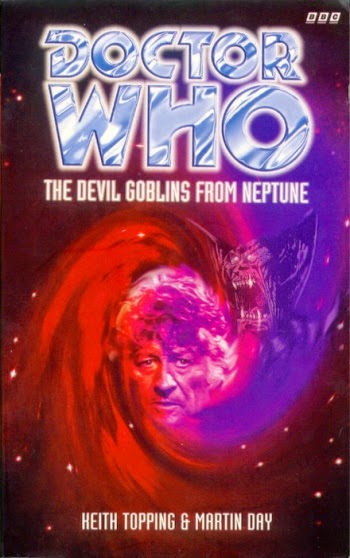
A little later, but earlier for the Doctor, came the BBC Novel The Devil Goblins from Neptune by Martin Day and Keith Topping. This is a stylish thriller pastiche with bags of atmosphere and retro scene-painting. Like Russell, the authors play about a bit with the idea of UNIT and global politics, and with a similar sense of reconciliation - but in a much more mischievous mood - they tie together a lot of the random characters of early 1970s Who to suggest the crazy world of Who's Britain.

Russell's novel has a lovely, warm portrayal of the Third Doctor and some fun stuff for Liz to do - by contrast, this novel has some fun action for the Doctor to get into, and some really convincing character work for Liz: it really suggests the cool cynicism and wit of the woman we see in 'Spearhead from Space', the character slightly diluted in successive appearances (though back to the fore in 'Ambassadors of Death').


It's great that Russell's novel is back in print, and I have cautious hopes that more of this era of Who (including The Devil Goblins) will slowly become available once more, and perhaps be followed by new adventures in prose. Yes, we get more of the Third Doctor in these stories, more of Liz Shaw too, but there are other interesting things going on too, with history, subversion, making connections, building background - sometimes they don't quite work out, and to some readers they will seem eccentric exercises, but to me they are a wonderful aspect of fan re-reading and re-writing, critical and creative at once.


And I'd love to have a go, myself!

Saturday, 27 September 2014

Inferno


One of the striking things about Inferno - which, at only the fourth story, concludes this first season of the new Doctor - is that unlike the other three, it doesn't obviously rip off (or rather, homage) anything from Nigel Kneale's Quatermass serials. It's also remarkable for being quite unlike the Doctor Who of previous seasons, and what was to come. It's a fascinating story that rewards re-viewing.

Okay, so there is an initial family resemblance to the TV work of Nigel Kneale, and particularly his famous creation, the rather Doctorish Professor Quatermass. We're in another sinister industrial unit, and we're digging into the surface of the Earth. It's almost a reimagining of The Quatermass Experiment, heading in the opposite direction - trespassing beyond human experience, uncovering a violent potential in ourselves.

And at this point, whilst it would require a heavy rewrite, this could have been made with Patrick Troughton's Doctor. The green ooze that possesses and transforms men into monsters is not a million miles away from the stinky seaweed that did similar stuff in Fury from the Deep. It would actually feel quite derivative if this was Patrick Troughton poking about in machinery and arguing with the base's hotheaded boss.

But Inferno takes things in an entirely new direction for Doctor Who. It is closest in genre to the dreamlike tales of the Celestial Toyroom or the Land of Storybook Characters that the 1960s toyed with so memorably. Here is the programme's cosy set-up (only four stories in, albeit over twenty actual episodes) inverted. The Inferno disaster itself becomes almost secondary to the actual story. You could easily substitute the events of Spearhead or Silurians here. It's a nightmare world.

You couldn't tell this story with the Second Doctor, Jamie and Zoe - or rather, you could, just about (evil Jamie, evil Zoe) but it would have about as much substance as a toot on a recorder. Liz and the Brigadier belong to 'our' world, and that they are different tells us, immediately, how different this other world is and how high the stakes. It's more fun - more exciting - and there is more potential in our understanding of those characters, even if we fans can get more from our speculations than the writer gives us in dialogue, the emphasis being more on drama than psychology.

It's the new Doctor's first Tardis trip, and it takes us somewhere more alien than Dulkis, to his biggest challenge in a long time - alone and friendless, with no handy gizmos, no means of escape or even shelter (how different it would be if the whole Tardis had transported him), trying to win the trust of a paranoid people. The most shocking thing is that he succeeds, but also fails, horribly - escaping with his life but no-one else's. I'm watching The Mind of Evil this week, and there's a subtle allusion to Inferno, the Doctor describing a fiery apocalypse as a memory that still haunts him.

Jon Pertwee's Doctor is less mercurial than his predecessor. Having to defend himself in that kangaroo court seems to have hardened his character - he's loud, flamboyant, outspoken, angry. He no longer sneaks about in the background or covers genius with bluster. But in this season, we've seen him new facets of his character that are compelling. Put through several ordeals, he remains eminently himself, a loud voice in favour of peace. This story alone stretches Pertwee's performance: he's a stellar leading man, and he makes the Doctor a vital, convincing character.

It's strange - looking back from the vantage point of Season 8 - seeing what a strong character Season 7, necessary for a 'dark mirror' story like this. It's telling stories its previous era never could, or never tried to. It's ignoring all the easy choices - Daleks, Cybermen, Yeti. Inferno demonstrates how many elements it can draw into one story - and make work: the Doctor's role at UNIT but also his desperate longing for escape, his sense of our world as home, the scale of the threats he can predict, his limited powers, and what our world is like without him.


And a last word should go to Caroline John, who leaves us on a laugh - a laugh at the Brigadier (after telling him, 'I don't quite care for your tone!') and the Doctor (who she has watched take his opportunity and fly away from our world in his mysterious Tardis, or did he die?). She's an amazing performer and I've loved her portrayal of Liz. One more season of this team would have been wonderful - going into the strange relationships of the characters, in these lovely long, slow, wintry stories of folk horror and our fragile planet. And more Liz Shaw, and Liz in space, and Liz saying goodbye. It's a credit to these four marvellous stories that they leave us wanting more.


Monday, 11 August 2014

The Ambassadors (TWANG!)of Death

In the past fortnight, whilst watching the Third Doctor's tangle with the British Space Programme, I decided to renew my acquaintance with its progenitor, Professor Bernard Quatermass. While the Doctor was dealing with a mysteriously empty space rocket, I watched (and read, in Penguin) about the Professor dealing with a mysteriously empty space rocket, and not longer after the Doctor went heroically into space to deal with the problem himself, the Professor went heroically into space to deal with his. I don't know if fan fiction has yet recorded the meeting of these two great minds, perhaps in the lounge of some Marylebone pub, but what with their shared experience of ancient inhabitants of Earth, uncanny meteorites, possession, sinister factories and deadly plant creatures, they wouldn't be stuck for conversation.

Just so long as they weren't later joined by the Professor's journalist friend, Hugo Conrad (played marvellously by Roger Delgado). That might have been awkward. (There's a less exciting but somehow more apt casting connection between the two worlds, in the form of Cyril Shaps: in Quatermass II, he's the technician who guides the Professor in his rocket toward the mysterious Thing on the dark side of the Earth - in Doctor Who, he's Viner, landing a rocket with a bunch of other astronauts to dig up the Tomb of the Cybermen, and even more appropriately, he's a discredited scientist blackmailed into helping the villains in - The Ambassadors of Death!)

The more you watch, the more you gasp in disbelief at the ideas, plot twists and images half-inched by Doctor Who (though interestingly, unless I've miscalculated, only in the Second Doctor's adventures and onward - even The War Machines doesn't feel that much like a Nigel Kneale story). And who can blame them? One of the fun things about Doctor Who is that the Doctor himself is fairly unique as a protagonist, and it's fun to drop him into other people's stories and see how he messes them up. The Doctor's alien qualities give a very specific and interesting twist to And The Silurians, The Ambassadors of Death and, of course, Inferno, whilst The Web of Fear, Spearhead from Space and The Seeds of Doom (to name the three most Knealeian stories) benefit from a more flamboyant, flippant or eccentric hero.

The Ambassadors of Death is a terrifically fun story, albeit with only a couple of lapses (somewhere round the middle, and right at the end). It plays off adult viewers' memories of Quatermass as much as it explores its child viewers' expectations. Much as it does steal from Nigel, there's lots of evidence here that the production team care about Doctor Who as a discrete entity with a particular moral stance: so, immediately following And The Silurians, we have a benevolent alien race and a highly negative depiction of military paranoia. When I was watching it, I kept waiting for the Brigadier to be given something to do - it's still weird to have him in every story - and suddenly he got it, stumbling upon a conspiracy of British Intelligence, arrested by his own men and obliged to make a getaway in Bessie. There's no overt connection made between this story and the last, but I think perhaps this is where the Brigadier realises that the Doctor is right: he sees his own paranoia in a dark mirror.

The action is brilliantly directed, and everything seems to take place in a decidedly moody winter's landscape. Bessie's hood is up, Liz Shaw makes sure to keep her hat on, and of course, the Ambassadors are careful not to unzip their space suits. It's bitter! The Doctor's in a terrible mood throughout the story, which somewhat detracts from the action - he takes himself so very seriously, all of a sudden, and there's really not enough banter between him and Liz Shaw, even when she brings him a mug of tea in his redesigned Tardis console room and he can't take his eyes off the telly. I've decided Liz has entered my pantheon of great Doctor Who companions. I want there to be hundreds of spin off novels about her.

Like all good companions, she exists on the fault-line which runs through Doctor Who between high seriousness and high camp. Her performance is wonderfully intense - helped along by some freaky, Ghost Stories for Christmas video effects when the Ambassador temporarily takes his hat off to her - but her outfit wouldn't look out of place on Lulu at Eurovision. Meanwhile, her fellow technicians look soberly into camera while droning on about the space ship intercepting the Doctor's rocket, as though heavily sedated. Jon Pertwee, too, is playing it very straight - but presumably he can't see how rudimentary is the video effect overlaying him into a giant segment of satsuma. And how else can you respond to Docteur Tartalian (never the same accent twice).

However much Doctor Who is inspired by Quatermass, it is always itself, always somehow ludicrous, funny and frightening in its own special way. And along with all that comes something Quatermass doesn't have - aliens who come in peace.


Oh, and Sergeant Benton's arrived!

Friday, 1 August 2014

Doctor Who and the Silurians

Like a holographic image, perspective is crucial with Doctor Who. From a certain angle, it appears to be a single, coherent structure: a series of adventures about a hero with a changing face, stretching continuously across five decades and more. This illusion is preserved because of certain choices by production teams - unlike John Steed of The Avengers, the Doctor never actually experiences the same adventure twice (despite his earliest stories being unavailable to audiences immediately they were broadcast) and changes in cast and location are woven into the series with various attempts at dramatic seriousness (the sadness of a companion leaving, the upheaval of a Doctor's regeneration).

It's all a complete illusion, of course. Successive writers brought their interpretation of the character to the script, the script editor ensured nothing jarred too badly, the actor incorporated it into his performance, and the fans did the rest.

I thought about this illusion again this week, when some friends were discussing how best to watch Doctor Who if you were entirely new to it. I, typically, found myself on the fence. (Ouch.) I couldn't help agreeing that the chronological viewing experience is not really 'orthodox' or even very representative. There have never been more than a small handful of viewers who have seen the show in that way, and it was never made for them. Every audience of the show has had a successive, idiosyncratic, partial, selective and slightly mistaken idea of what the Doctor was doing before the current adventure.

That's how I saw the show. I was six when the series ended, and ten when I became a fan. I watched stories based on their availability at my local library, or based on relatives' decisions at Christmas, completely out of order till 2005.

But there is something alluring about that idea of an ongoing narrative. Like the idea that Ian and Barbara introduce an element of humanity into the Doctor's life which make him the man he is today, or that the Second Doctor and Jamie travlled as agents of the Time Lords between stories. The illusion is particularly strong during Season 7, when some attention has been given to the Doctor's relationship with his new surroundings.

This wonderfully dark (in all senses) story, and particularly its ending, are a moment of lost innocence for the Doctor. For a hundred years or so, it seems, he's been the one in charge - the hero of the hour, with young humans aboard his Tardis, who generally do what he says. Now he's like a companion to the Brigadier, somewhat subservient to his priorities and his morality. In this story, his trust is abused and the slightly starchy young human - with whom he was so matey when they encountered the Yeti and Cybermen - turns out to be disobedient, somewhat powerful, and rather dangerous.

The Brigadier becomes an interesting figure, partly because the writers are not very interested in his psychology, and therefore he comes off as slightly unreal - perhaps even unwell. In The Web of Fear, he's impressively open-minded. In The Invasion, we see that he has established this military 'unit' to deal with the unexplained. By Spearhead from Space, despite his charm, he is something of a loner. He replies to Liz Shaw's scepticism with the practiced calm of someone who has trod a solitary path for quite a while. He is waiting for his one true ally, the Doctor, to come back.

But he treats the Doctor - whose change of appearance he finds impossible and then credible within a short space of time - with suspicion, even as a child. The pair behave as if it was the same early days of their friendship, but in fact they are increasingly uncertain of one another. In this story he trusts the Doctor throughout, in spite of all hell breaking loose. He is patient to the end. But the Doctor learns not to mistake that for friendship.

This is the story of the Doctor being taken to the Wenley Moor research station by the Brigadier, much as the Doctor once took his companions to new and mysterious places. The Brigadier has an impressive eye for weird shit waiting to go off - the eye of a fanatic, almost. And not only are the Silurians an unknown 'weird shit' quantity for all concerned, but the Doctor himself proves to be a dangerous quantity. The Brigadier saves his life and provides the resolution to the story. The Doctor, by contrast, nearly gets the Brigadier killed.

It's a fascinating new development in the life of a man who used to be carefree and now finds himself involved in other people's lives: Liz, the Brigadier, the planet Earth, the Silurians. The Doctor is involved in a bigger adventure now - the ongoing history of the human race. At one point, he recklessly gambles humankind's safety, hoping to set history on a new course, a 1970s or 1980s Earth shared by humans and intelligent reptiles. The denouement is not merely a revelation about the Brigadier's powers, but also the Doctor;s disempowerment.


Of course, it's all in my mind. Jon Pertwee doesn't know how matey he used to be with the Brigadier. He doesn't realise how much things have changed for them - and Malcolm Hulke doesn't know that the Doctor will end the season by meeting a dark mirror of his friend (or begin the next season with his own dodgy doppelganger turning up). It's all a product of watching the series in sequence, a series made by people deeply engaged with its possibilities, its ideas of morality and terror. The effect is perverse and illusory - but also fascinating.